
LLM Reference
LLM Reference is the essential tool you need to instantly find, compare, and pick the best AI model and provider for your project.
Visit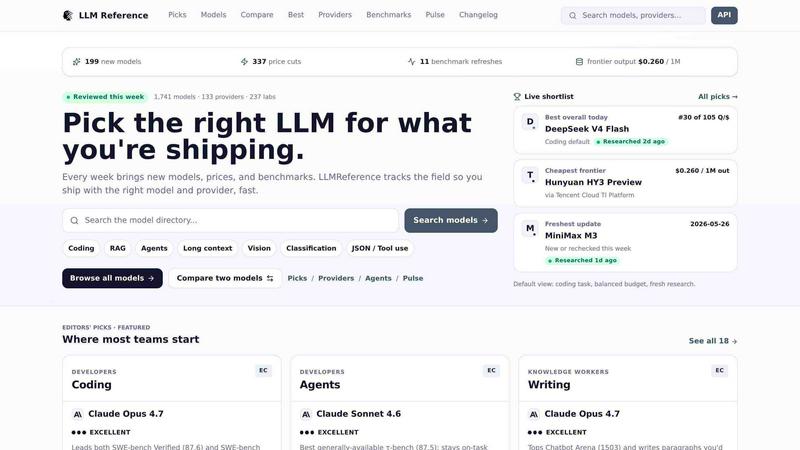
About LLM Reference
LLM Reference is an essential, decision-support directory built for engineers and technology leaders who must choose the right large language model (LLM) and provider in today's fast-moving AI landscape. This product is a single, trustworthy resource that eliminates the need to hunt through scattered sources. It tracks over 1,700 models from more than 130 providers and 235 research labs, with data refreshed weekly to include new releases, verified price changes, and benchmark updates. The core value proposition is simple: stop wasting time and start shipping with confidence. Whether you are building a coding assistant, an agentic workflow, a writing tool, or a research pipeline, LLM Reference gives you the power to compare models side-by-side, see who offers the cheapest pricing for frontier output, and browse curated editors' picks for specific tasks like coding, agents, writing, research, image generation, and video creation. The site is designed for fast triage, enabling you to quickly identify the right model for your job, determine the most cost-effective provider, and get back to building. With a Pulse feed that highlights what changed this week, including new models, price cuts, and benchmark refreshes, LLM Reference keeps you informed without the noise. It is built by the Data Advantage project and updated daily, making it an indispensable resource for anyone who needs to stay current with the exploding LLM ecosystem.
Features of LLM Reference
Comprehensive Model Directory
The core of LLM Reference is its exhaustive directory, tracking 1,843 language models from 140 providers and 247 labs. This feature is indispensable for finding the exact model you need for any task. You can search the entire directory by name, task, or provider, and browse models filtered by specific use cases like coding, RAG, agents, long context, vision, classification, and JSON or tool use. This directory is updated weekly, ensuring you always have access to the latest frontier models without the risk of relying on outdated information.
Curated Editors' Picks
LLM Reference features expertly curated Editors' Picks for six critical task categories: Coding, Agents, Writing, Research, Image generation, and Video creation. Each pick comes with a detailed rationale, benchmark scores, and an "EXCELLENT" rating for top performers. For example, Claude Fable 5 is the top pick for coding with an 80.3% SWE-bench Pro score, while Veo 3.1 is the best video model. This feature is essential for teams that need a trusted, vetted starting point and do not have the time to evaluate every model themselves.
Real-Time Pulse Feed
The Pulse feed is a weekly changelog that tracks every significant market movement. It reports on 177 new models, 53 verified price cuts, and 368 benchmark refreshes in a single week. This feature is a must-have for staying ahead of the curve. It highlights the freshest updates, such as the cheapest frontier output pricing at $0.260 per 1M tokens for Hunyuan HY3 Preview via Tencent Cloud TI Platform. This ensures you never miss a critical price reduction or a breakthrough model that could save your team money or improve performance.
Side-by-Side Model Comparison
The Compare feature allows you to put two models head-to-head, examining their performance across key benchmarks and pricing. This is critical for making data-driven decisions. You can compare top contenders like Claude Fable 5 versus GPT-5.5 or Claude Opus 4.8 versus its predecessor. The tool provides a clear, unbiased view of trade-offs, enabling you to choose the model that best balances cost, capability, and context window for your specific application.
Use Cases of LLM Reference
Choosing a Production Coding Model
For engineering teams shipping a coding assistant or agent, LLM Reference is the definitive tool. Instead of relying on hype or marketing, you can directly compare models like Claude Fable 5, which scores 80.3% on SWE-bench Pro, against GPT-5.5. The Editors' Picks section provides a verified recommendation, and the pricing data shows you the most cost-effective provider for that model. This use case is essential for ensuring your product is built on the most capable and reliable foundation.
Optimizing AI Spend for Frontier Output
Technology leaders and procurement teams must constantly optimize costs. LLM Reference's Frontier Pricing tracker is a must-use feature. It instantly shows the cheapest provider for the most powerful models. For instance, it identifies Hunyuan HY3 Preview at $0.260 per 1M output tokens as this week's cheapest frontier model. This allows you to redirect budget from overpriced providers to more efficient ones without sacrificing performance, directly impacting your bottom line.
Selecting a Model for Agentic Workflows
Building reliable agents requires a model that excels at tool use, long context, and self-correction. LLM Reference's Agents board is indispensable for this task. It highlights Claude Sonnet 4.6 as the best generally-available agent model with a tau-bench score of 87.5, noting its ability to stay on-task across long tool loops. You can then compare it against other contenders like Claude Fable 5 or GLM-5, ensuring your agent is built on a model that minimizes errors and maximizes autonomy.
Researching and Validating New Model Releases
For AI researchers and analysts, keeping up with the weekly deluge of new models is a priority. The Pulse feed and Changelog are essential for this use case. You can see every new model, from DiffusionGemma 26B A4B IT to North Mini Code 1.0, along with their benchmark scores. This allows for rapid validation and integration of cutting-edge research into your pipeline, ensuring you are always working with the most advanced tools available.
Frequently Asked Questions
How often is LLM Reference updated?
LLM Reference is updated daily, with a major refresh cycle every week. This ensures that the data on models, prices, and benchmarks is always current. The Pulse feed highlights exactly what changed in the most recent week, including new models, price cuts, and benchmark refreshes, so you are never working with stale information.
Is LLM Reference free to use?
Yes, LLM Reference is a free resource. It is built by the Data Advantage project and is accessible to anyone who needs to navigate the LLM ecosystem. There is no paywall for accessing the model directory, Editors' Picks, Pulse feed, or comparison tools.
How are the Editors' Picks determined?
Editors' Picks are determined by a rigorous analysis of verified benchmark scores, pricing data, and real-world performance reports. The team evaluates models against specific task categories like coding, agents, and writing. Picks are updated as new models and benchmark data become available, ensuring the recommendations remain the most relevant and high-performing options.
Can I compare models from different providers side-by-side?
Absolutely. The Compare feature is designed specifically for this purpose. You can select any two models from the directory and view a direct comparison of their benchmark performance, pricing per token, and context window. This is the most efficient way to make an informed decision between, for example, a model from Anthropic and one from Google DeepMind.
Similar to LLM Reference

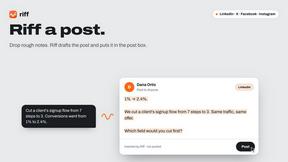
Riff
Free Chrome extension. Paste your rough point and Chrome's built-in AI writes a fresh reply for that post on X, LinkedIn, Facebook or Instagram.

Capafy AI
Agent Skills marketplace: discover expert AI agents, run them online, or publish a Skill and earn from every sale.

Memorable Contact
Memorable Contact helps you remember people, save conversation details, find contacts using AI-powered search, and share digital business cards



amaze.directory
Every AI tool here was opened and used on a real task before it went in. Free to submit.