ScopeSnap vs Skene
Side-by-side comparison to help you choose the right tool.

ScopeSnap
ScopeSnap instantly turns your discovery notes into client-ready proposals and accurate project scopes.
Last updated: March 18, 2026

Skene transforms your codebase into a PLG engine, driving seamless onboarding and retention through automated growth.
Last updated: February 28, 2026
Visual Comparison
ScopeSnap
Skene
Feature Comparison
ScopeSnap
AI-Powered Scope Generation
This is the foundational feature. You simply paste in raw materials from your discovery process, such as meeting transcripts, email threads, or bullet-point notes. ScopeSnap's AI then analyzes this text to automatically identify and break down the project into structured epics and detailed scope items. It intelligently surfaces critical open questions and flags underlying assumptions that need client clarification, ensuring nothing important is missed from the very beginning.
Interactive Scope Refinement & Estimation Board
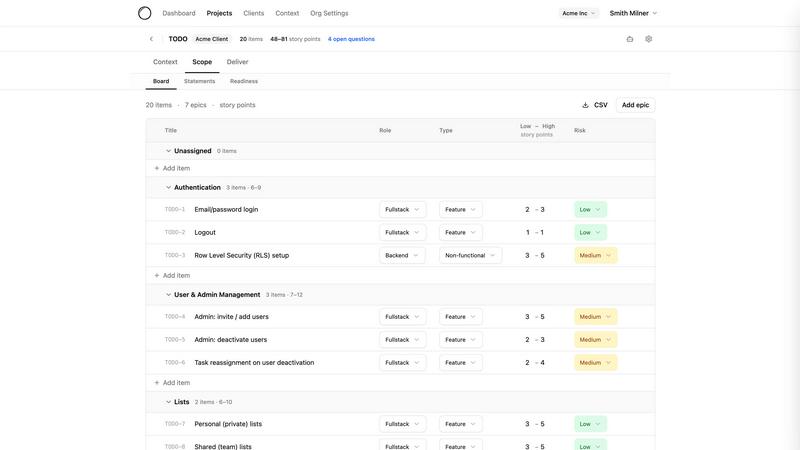
The generated scope is not a static document. It is presented in an interactive, kanban-style board where you can review, edit, and organize every item. This is where you take control: you can assign roles (e.g., front-end, back-end), set time or cost estimates for each task, and directly resolve the open questions flagged by the AI. This collaborative refinement process is essential for achieving a confident and accurate final estimate.
Automated Proposal & SOW Creation
Once your scope is refined and estimated, ScopeSnap eliminates the final manual hurdle. With one click, it automatically generates a professional, polished Proposal or Statement of Work document. This client-ready deliverable is formatted for clarity and includes your defined scope, estimates, assumptions, and terms, saving you hours of drafting, formatting, and writing from scratch.
Centralized Project Scoping Workspace
ScopeSnap provides a single, unified workspace for the entire pre-project lifecycle. From ingesting initial discovery notes, through structuring the backlog and estimating, to generating the final proposal, everything is contained in one platform. This centralization is crucial for maintaining organization, ensuring consistency across projects, and having a clear audit trail of how scope and estimates were derived.
Skene
Automated User Flow Optimization
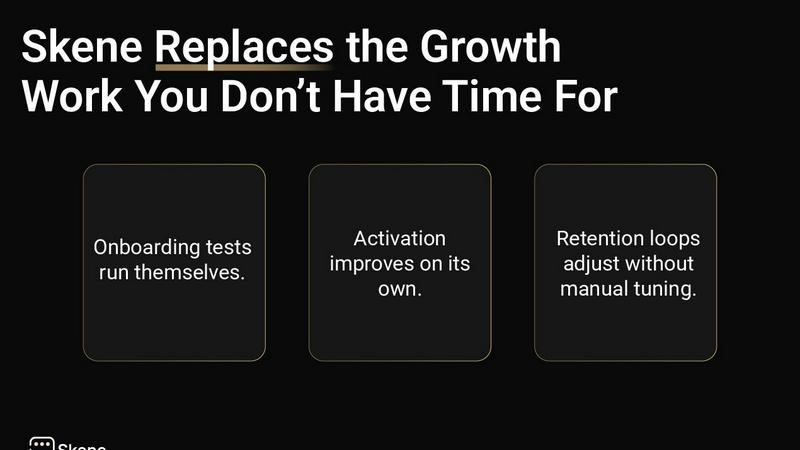
Skene continuously analyzes user interactions within your product to identify friction points that hinder user activation. By automatically generating and testing optimized user flows, Skene ensures that onboarding processes are effective, making the path to activation smoother and more intuitive.
Contextual Insights from Your Codebase
Leveraging signals directly from your codebase, Skene provides rich contextual insights that facilitate informed decision-making. This feature allows developers to understand user behavior in real time, ensuring that adjustments and enhancements are data-driven and relevant to the current state of the product.
Rapid Setup and Integration
Getting started with Skene is incredibly fast—setup takes less than 60 seconds. Simply connect your GitHub or GitLab repository, and Skene automatically analyzes your codebase to generate tailored PLG flows, eliminating the need for extensive manual input or complicated integrations.
Outcome-Based Pricing
Skene's pricing model is designed to be fair and aligned with user success. You only pay when customers successfully complete their onboarding journey, making it a cost-effective solution for startups. The free tier includes five completed onboardings per month, with additional bundles available for growth.
Use Cases
ScopeSnap
For Freelance Developers Closing New Clients
A solo developer can use ScopeSnap to quickly turn a post-call jumble of ideas into a structured, professional proposal. This demonstrates competence and thoroughness to potential clients, significantly increasing win rates. It prevents under-scoping and gives the freelancer a clear, defendable plan and price for the project, which is essential for managing their time and income effectively.
For Software Agencies Standardizing Sales Processes
Agencies can implement ScopeSnap to create a consistent, repeatable scoping methodology across their entire sales team. It ensures every project estimate follows the same rigorous process, improving accuracy and protecting profit margins. It also drastically reduces the time senior developers or project managers spend on sales support, freeing them for billable work.
For Consultants Defining Project Boundaries
Management or technical consultants who define project requirements for clients can use ScopeSnap to structure their recommendations. The tool helps ensure all aspects of a solution are considered and documented. The automatically generated SOW becomes a perfect handoff document to a development team, with clear, actionable items and estimates.
For Handling Vague or Complex Project Requests
When a client approaches with a large, complex, or poorly defined idea (e.g., "build an app like Uber"), ScopeSnap is indispensable. The AI helps break down the monolithic concept into core epics and features. The iterative refinement process, guided by surfaced questions, forces clarity and allows for phased, estimable project planning, de-risking the engagement for both parties.
Skene
Improving Onboarding Efficiency
Indie developers can utilize Skene to enhance their onboarding processes, providing new users with a seamless introduction to the product. By optimizing user flows based on real-time data, developers can significantly reduce the time it takes for users to achieve their first success within the product.
Driving Feature Adoption
Startups can leverage Skene to drive feature adoption by identifying which features are underutilized and creating targeted user flows that encourage engagement. This ensures that users are aware of and can easily access valuable features, ultimately enhancing the overall user experience.
Enhancing Retention Strategies
By continuously analyzing user behavior and identifying drop-off points, Skene helps startups refine their retention strategies. This proactive approach allows businesses to implement timely interventions that keep users engaged and reduce churn.
Streamlining Product Development
With Skene automating growth processes, developers can focus on building and improving their product rather than managing growth initiatives manually. This streamlined approach allows teams to innovate faster and respond to user needs more effectively.
Overview
About ScopeSnap
ScopeSnap is an essential AI-powered platform designed specifically for freelance developers, consultants, and software agencies. It solves the critical, time-consuming, and risky problem of project scoping and estimation. The tool transforms the chaotic aftermath of client discovery calls-scattered notes, vague requirements, and rough ideas-into a structured, actionable, and client-ready proposal. Its core value proposition is eliminating the guesswork and manual drudgery from the pre-project phase. By using AI to analyze input like call transcripts and notes, ScopeSnap automatically generates a detailed project backlog, surfaces assumptions and open questions, and provides a framework for accurate estimation. This structured process is non-negotiable for professionals who need to deliver reliable quotes, protect their margins, and build client trust. Finally, it compiles everything into a polished Statement of Work or proposal, turning hours of tedious work into a process that takes minutes. For anyone delivering custom software, ScopeSnap is not a luxury; it's a fundamental tool for operational clarity and business sustainability.
About Skene
Skene is a revolutionary, fully automated Product-Led Growth (PLG) iteration engine specifically designed for indie developers and early-stage startups. This innovative platform empowers users to accelerate their product growth without the need for a dedicated growth team. By continuously optimizing crucial processes such as onboarding, activation, and retention, Skene harnesses insights derived from customer interactions to significantly enhance the user experience. It intelligently observes user actions to pinpoint friction points that lead to activation drop-offs and automatically creates and tests improved user flows based on these insights. The result is a self-optimizing onboarding process that ensures smoother activation paths and evolves long-term retention strategies over time. With Skene, developers can focus their efforts on building exceptional products while the platform takes charge of growth, serving as a "growth team in a box" that elevates PLG strategies without the need for additional hires.
Frequently Asked Questions
ScopeSnap FAQ
What kind of input does ScopeSnap need to work?
ScopeSnap is designed to work with the unstructured text you already have from discovery. The most effective inputs are verbatim transcripts from discovery calls or meetings (from tools like Otter.ai or Rev), detailed notes you've taken, or email chains discussing requirements. The more context you provide, the more accurate and comprehensive the initial scope breakdown will be.
How accurate are the AI-generated estimates?
ScopeSnap's AI is designed to structure scope and surface questions, not to provide final estimates. The initial breakdown gives you a framework, but the accuracy comes from you, the expert. You review each generated task, assign your own estimates based on your experience and team velocity, and refine the scope. The AI ensures completeness; you provide the precision.
Can I customize the generated proposals?
Yes, absolutely. The proposals and Statements of Work generated by ScopeSnap are fully customizable. You can edit all text, adjust formatting, add your company logo and branding, and modify terms and conditions before sending them to your client. The automation creates a complete, professional first draft for you to finalize.
Is ScopeSnap suitable for very small or fixed-price projects?
Yes, it is essential for these project types. For small projects, it ensures you don't overlook details that could turn a quick job into a loss leader. For fixed-price projects, a precise, well-defined scope is non-negotiable to avoid scope creep and protect your profitability. ScopeSnap provides the structured process needed to define the exact boundaries of a fixed-price agreement.
Skene FAQ
What is PLG software?
PLG (Product-Led Growth) software enables users to discover value in your product independently, without the need for sales or customer success teams. It automates the user journey, guiding users toward activation, driving feature adoption, and enhancing retention through the product itself.
How is Skene different from traditional customer experience software?
Unlike traditional customer experience tools that require manual tour creation and maintenance, Skene reads your codebase to automatically generate onboarding, analytics, and lifecycle automation. When you push code, everything updates seamlessly, eliminating the need for constant adjustments.
How long does it take to set up?
Setting up Skene is extremely quick, taking less than 60 seconds. You simply connect your GitHub or GitLab repository with read-only access, and Skene automatically analyzes your codebase to generate personalized PLG flows, requiring no code changes or API modifications.
Is my code secure with Skene?
Yes, your code is secure with Skene. The platform only requires read-only access to your repository, and all analysis occurs in a secure, isolated environment, ensuring that your intellectual property remains protected.
Alternatives
ScopeSnap Alternatives
ScopeSnap is a productivity and project management tool that uses AI to help freelance developers and agencies transform initial project ideas into structured scopes, estimates, and client-ready proposals. It addresses the common pain points of slow, risky estimation and vague project requirements that plague custom software development. Users often explore alternatives for various reasons, such as budget constraints, the need for different feature sets, or integration with a specific existing platform. The search for the right tool is driven by the necessity to find a solution that aligns perfectly with their operational workflow and business model. When evaluating alternatives, it is essential to prioritize tools that offer clarity in breaking down complex projects, provide reliable estimation frameworks, and streamline the proposal generation process. The right choice must eliminate ambiguity and reduce the administrative overhead of project scoping, which is a non-negotiable requirement for profitable and sustainable client work.
Skene Alternatives
Skene is an advanced automated Product-Led Growth (PLG) iteration engine that focuses on enhancing onboarding and retention for indie developers and early-stage startups. By transforming your codebase into a growth engine, Skene allows teams to optimize their products without the need for dedicated growth personnel. Users often seek alternatives to Skene for various reasons, including pricing, specific feature sets, or the need for compatibility with different software platforms. When choosing an alternative, it is essential to consider aspects such as ease of integration, the depth of analytics provided, and the level of automation in user flow optimization. Selecting the right solution can significantly impact your product's growth trajectory. Look for platforms that offer real-time analytics, seamless integration with your existing codebase, and robust features to facilitate continuous optimization. A well-rounded alternative should not only meet your immediate needs but also support long-term growth strategies as your user base evolves.