diffray vs Fallom
Side-by-side comparison to help you choose the right tool.

diffray
Diffray uses 30 AI agents to catch real bugs in your code, not just nitpicks.
Last updated: February 28, 2026

Fallom provides essential real-time observability for tracking and analyzing all your LLM and AI agent operations.
Last updated: February 28, 2026
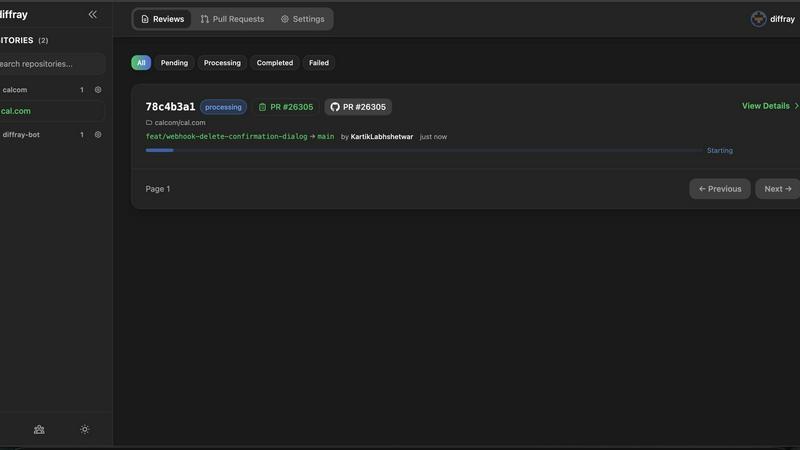
Visual Comparison
diffray
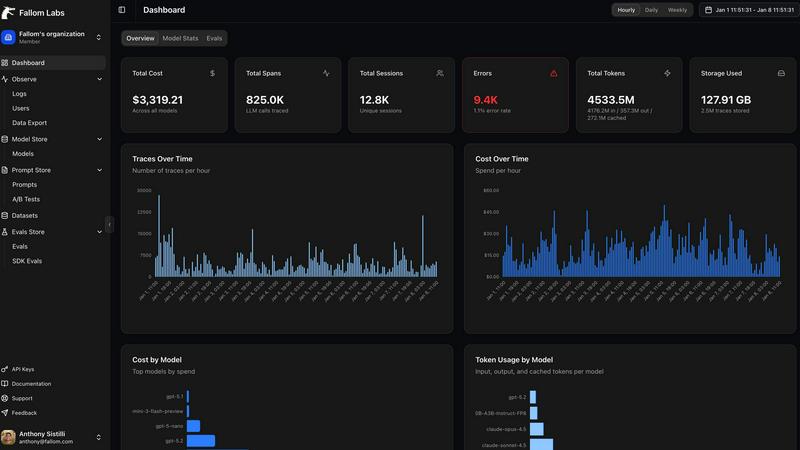
Fallom
Feature Comparison
diffray
Multi-Agent Specialist Architecture
diffray's foundational feature is its team of over 30 specialized AI agents, a critical upgrade from generic, single-model reviewers. Each agent is a dedicated expert in a specific domain, including security vulnerability detection, performance anti-patterns, bug logic, SEO best practices for web code, and data consistency checks. This specialization is essential for eliminating irrelevant style nitpicks and false positives, ensuring every piece of feedback is precise, actionable, and originates from a virtual expert in that exact field.
Full Codebase Context Awareness
This is the indispensable engine that separates diffray from speculative tools. The platform performs a deep, codebase-aware investigation by analyzing your entire repository—not just the diff. It understands your project's existing patterns, custom libraries, and architectural decisions. This critical context allows diffray to identify issues like duplicate utility functions, API type drift, and problematic database operations that other tools miss, while respecting and avoiding commentary on patterns your team has already standardized.
Noise-Free, Actionable Feedback
diffray is engineered with a zero-tolerance policy for noisy, ineffective feedback. By leveraging its specialist agents and deep context, the platform filters out irrelevant suggestions and false positives that plague traditional AI reviewers. The result is a clean, prioritized list of findings that developers can immediately trust and act upon. This direct focus on high-signal issues is an absolute necessity for maintaining developer trust and accelerating the review cycle without distraction.
Enterprise-Grade Security & Integration
Designed for serious engineering teams, diffray integrates seamlessly into your existing development workflow. It connects directly with GitHub, GitLab, and other version control systems, providing automated, inline comments on pull requests. The platform operates with a commitment to security, ensuring your code is analyzed in a protected environment. This seamless, secure integration is a must-have for maintaining velocity and code quality without introducing friction or risk.
Fallom
End-to-End LLM Tracing
Fallom provides mandatory, granular visibility into every interaction within your AI stack. It automatically traces each LLM call, capturing the full context including the exact prompt sent, the model's output, any intermediate tool or function calls with their arguments and results, token counts, latency, and calculated cost. This complete trace is fundamental for debugging complex agent workflows and understanding the precise chain of events that led to any given response.
Real-Time Cost Attribution & Analytics
Gaining control over spiraling and unpredictable AI costs is a critical business necessity. Fallom offers precise, real-time cost tracking broken down by model, user, team, or even individual customer. This feature provides the transparency required for accurate budgeting, internal chargebacks, and identifying inefficient or expensive patterns in model usage, ensuring every dollar spent on AI is accountable and optimized.
Compliance-Ready Audit Trails
Meeting regulatory standards like the EU AI Act, GDPR, and SOC 2 is not optional for enterprise AI. Fallom is built with compliance as a core requirement, generating immutable, complete audit trails of all LLM interactions. This includes logging of inputs and outputs, model versioning, user consent tracking, and session history, providing the necessary evidence and traceability for legal and security audits.
Advanced Debugging with Timing Waterfalls
Diagnosing performance issues in multi-step AI agents is a fundamental challenge. Fallom's timing waterfall visualizations are an indispensable tool for this, breaking down the latency of each step in an agent's execution. You can instantly see how much time was spent on each LLM call, database query, or custom function, allowing you to pinpoint and resolve latency bottlenecks that degrade user experience.
Use Cases
diffray
Accelerating Pull Request Reviews for Velocity
For teams under pressure to ship features faster, diffray is an essential accelerator. By automatically providing precise, context-aware reviews on every pull request, it slashes the average review time from 45 minutes to just 12 minutes. Developers receive immediate, expert-level feedback on security, bugs, and performance, allowing human reviewers to focus on higher-level architecture and design. This use case is critical for any team looking to reduce cycle time and increase deployment frequency without sacrificing quality.
Enforcing Code Quality & Best Practices at Scale
As engineering teams and codebases grow, consistently enforcing quality and best practices becomes a monumental challenge. diffray acts as an always-on, expert senior engineer on every team. It automatically enforces coding standards, identifies anti-patterns, and ensures consistency across the entire repository. This is a necessity for large enterprises and scaling startups to maintain a high-quality, sustainable codebase and effectively onboard new developers.
Proactive Security & Vulnerability Prevention
Security cannot be an afterthought. diffray's dedicated security agents proactively scan every code change for vulnerabilities like SQL injection, XSS, insecure dependencies, and secret key exposure. By catching these issues at the pull request stage—within the full context of the application—it shifts security left and prevents critical flaws from ever reaching production. This use case is an absolute must for any organization serious about building secure software from the ground up.
Eliminating Technical Debt & Bug Patterns
Technical debt and recurring bug patterns silently cripple productivity. diffray's investigative agents are specifically tuned to identify these insidious issues, such as duplicate code, non-atomic operations, memory leaks, and type inconsistencies. By flagging these patterns early and providing concrete fixes, diffray helps teams systematically pay down debt and break the cycle of recurring bugs. This is essential for maintaining long-term development velocity and system reliability.
Fallom
Proactive Production Monitoring & Incident Response
Teams must monitor their AI applications live to prevent minor issues from becoming major outages. Fallom's real-time dashboard allows engineers to watch LLM traffic, spot anomalies like latency spikes or error rate increases, and drill down into specific problematic traces immediately. This enables proactive intervention and faster mean-time-to-resolution (MTTR) for any production incidents involving AI components.
Optimizing AI Agent Performance & Reliability
Developing reliable, multi-step AI agents requires deep insight into their internal decision-making. Fallom allows developers to trace through complex agent sessions, review every tool call and LLM reasoning step, and analyze timing waterfalls. This is essential for refining prompts, improving tool orchestration, and eliminating inefficiencies or errors that cause agents to fail or provide poor results.
Enforcing Governance and Regulatory Compliance
For organizations in finance, healthcare, or any regulated industry, demonstrating control over AI systems is mandatory. Fallom provides the complete audit trail required to prove how AI models are used, what data they process, and that appropriate safeguards are in place. It supports compliance reviews and helps fulfill obligations under regulations concerning algorithmic transparency and data privacy.
Managing and Forecasting AI Operational Costs
Without visibility, AI costs can quickly become a major and unpredictable line item. Fallom gives finance and engineering leaders the tools to track spend per project, department, or product feature. This data is critical for forecasting budgets, implementing showback/chargeback models, and making informed decisions about model selection (e.g., choosing between GPT-4o and a more cost-effective model for certain tasks).
Overview
About diffray
diffray is the non-negotiable, multi-agent AI code review platform engineered to eliminate the crippling noise and ineffectiveness of traditional single-model tools. For development teams who are serious about code quality, security, and shipping velocity, diffray is an absolute necessity. It fundamentally transforms the code review process by deploying a dedicated team of over 30 specialized AI agents, each an expert in a critical domain like security vulnerabilities, performance bottlenecks, bug patterns, and data consistency. This architectural shift moves beyond generic, speculative feedback to deliver precise, actionable insights that developers can immediately trust and act upon. The platform's core, indispensable value is its deep codebase-aware investigation. diffray analyzes your entire repository context to understand your project's established patterns, libraries, and architectural decisions. This allows it to catch critical, context-sensitive issues that other tools completely miss—such as duplicate utilities, type drift, and non-atomic database operations—while intelligently avoiding redundant suggestions about patterns your team already uses. The result is a transformative developer experience with proven outcomes: an 87% reduction in false positives, 3x more real bugs caught, and PR review time slashed from an average of 45 minutes to just 12 minutes per week. diffray is a must-have for any engineering team, from fast-moving startups to large-scale enterprises, that demands intelligent, context-aware code review.
About Fallom
Fallom is the essential AI-native observability platform built specifically for the complexities of Large Language Model (LLM) and AI agent workloads. In a landscape where AI operations are critical but opaque, Fallom delivers the non-negotiable visibility that development and enterprise teams require. It provides comprehensive, end-to-end tracing for every LLM call in production, capturing vital data like prompts, outputs, tool calls, token usage, latency, and cost. This platform is a necessity for AI developers, data scientists, and enterprise teams who must monitor usage in real-time, ensure compliance with evolving regulations, and optimize costly AI operations. By offering a single OpenTelemetry-native SDK, Fallom enables instrumentation in minutes, eliminating blind spots. The core value proposition is absolute control: the ability to troubleshoot performance bottlenecks, attribute costs accurately across teams and models, and maintain robust audit trails for governance, all from a unified dashboard. Without Fallom, organizations are flying blind with their most critical and expensive AI initiatives.
Frequently Asked Questions
diffray FAQ
How is diffray different from other AI code review tools?
diffray is fundamentally different due to its multi-agent specialist architecture and deep codebase awareness. Generic tools use a single, general-purpose AI model that often floods reviews with irrelevant style suggestions and false positives. diffray uses over 30 AI agents, each a dedicated expert in domains like security, performance, and bugs. More critically, it analyzes your entire repository for context, allowing it to provide precise, actionable feedback that respects your established patterns and catches issues other tools miss.
What kind of issues can diffray actually find?
diffray's specialist agents are designed to find critical, substantive issues that impact code quality, security, and performance. This includes security vulnerabilities (e.g., injection flaws, insecure data handling), performance bottlenecks (e.g., N+1 queries, inefficient algorithms), logical bugs and anti-patterns, data consistency risks, duplicate code, and deviations from established project-specific best practices. It intentionally avoids superficial style nitpicks to focus on what matters most.
How does the codebase-aware analysis work?
When you integrate diffray with your repository, it performs an initial, secure analysis to understand your project's architecture, existing code patterns, libraries, and conventions. For every subsequent pull request, it evaluates the proposed changes within this full context. This allows it to determine if a suggested pattern already exists elsewhere, if a change could cause type drift in your system, or if a new function duplicates existing utility code, ensuring feedback is always relevant and intelligent.
Is diffray suitable for both small startups and large enterprises?
Absolutely. diffray is an essential tool for any team serious about code quality. For fast-moving startups, it acts as a force multiplier, providing expert-level review capabilities without the need to hire a large senior team, enabling them to ship faster and more securely. For large enterprises, it ensures consistency, security, and best practices are enforced automatically across hundreds of developers and complex, monolithic codebases, making it a non-negotiable component of the development lifecycle.
Fallom FAQ
How difficult is it to integrate Fallom into my existing application?
Integration is designed to be straightforward and fast. Fallom uses a single, OpenTelemetry-native SDK that can instrument your LLM calls in under five minutes. It works with all major LLM providers (OpenAI, Anthropic, Google, etc.) and frameworks, meaning you can add comprehensive observability without vendor lock-in or significant code changes.
Does Fallom store or have access to my sensitive prompt and response data?
Fallom offers robust privacy controls to meet different security needs. You can run the platform in a full "Privacy Mode" that disables content capture for sensitive data, logging only metadata like token counts and latency. Alternatively, you can use configurable content redaction rules. You maintain full control over what data is sent and stored.
Can Fallom help me test and improve my prompts and models?
Yes, absolutely. Fallom includes features for evaluation and testing, allowing you to run automated checks on LLM outputs for metrics like accuracy, relevance, and hallucination rates. Coupled with the Prompt Store for versioning and A/B testing different prompt variations, it provides a necessary framework for continuously improving your AI application's quality and reliability.
Is Fallom suitable for large-scale enterprise deployments?
Fallom is built specifically for enterprise-scale and compliance-focused requirements. It offers the security features, audit capabilities, and reliable data handling that regulated industries demand. The platform can handle high-volume traffic, provides detailed per-customer analytics, and supports the complex cost attribution needs of large organizations.
Alternatives
diffray Alternatives
diffray is an essential multi-agent AI code review platform in the development category, engineered to catch real bugs with over 30 specialized AI agents. It is a must-have for teams serious about code quality, security, and velocity. Users may seek alternatives for various critical reasons. These include budget constraints, specific feature requirements not covered by a platform, or integration needs with their existing development stack and workflow. The search for a different tool is often driven by the absolute necessity to find the right fit for a team's unique operational demands. When evaluating any alternative, it is imperative to prioritize a few non-negotiable criteria. You must look for deep, context-aware analysis that understands your full codebase to avoid noise. Specialized expertise across security, performance, and best practices is essential, as is a proven reduction in false positives that builds developer trust and accelerates review cycles.
Fallom Alternatives
Fallom is an essential AI-native observability platform in the development category, designed for real-time tracking and analysis of LLMs and agents. It provides critical visibility into production AI workloads, from prompts and outputs to costs and compliance. Users often seek alternatives for various reasons, including budget constraints, specific feature requirements not covered, or the need to integrate with an existing tech stack. The observability landscape is evolving, and different teams have unique priorities. When evaluating an alternative, prioritize solutions that offer comprehensive tracing, real-time monitoring, and robust audit capabilities. Essential considerations include ease of integration, granular cost attribution, and the ability to meet your specific compliance and security standards.