CCAPI vs Renderly
Side-by-side comparison to help you choose the right tool.

CCAPI
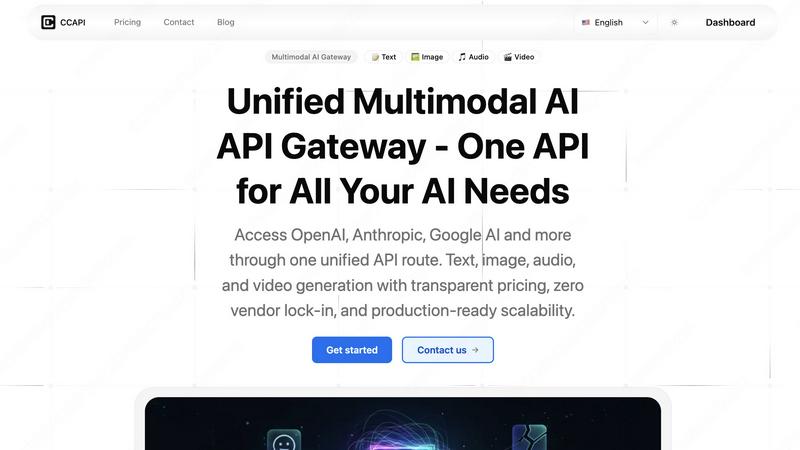
CCAPI is your unified gateway to all major AI models, ensuring reliable access with automatic failover.
Last updated: February 28, 2026

Renderly
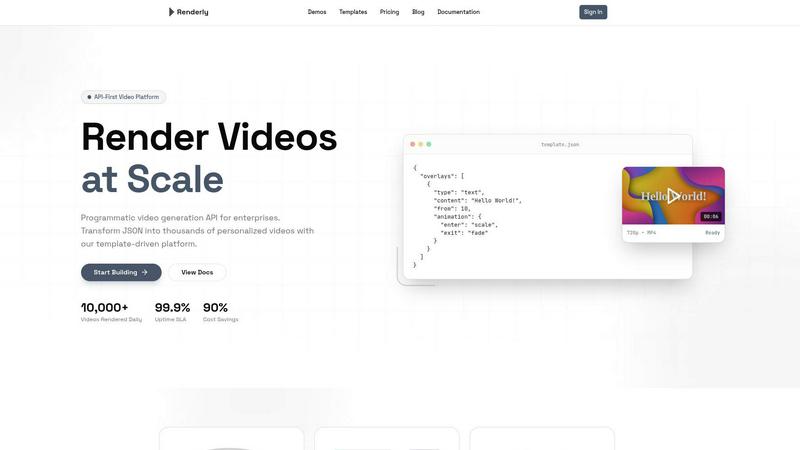
Renderly automates video production at scale, enabling enterprises to generate thousands of personalized videos.
Last updated: February 28, 2026
Visual Comparison
CCAPI
Renderly
Feature Comparison
CCAPI
Unified Multimodal API
CCAPI consolidates access to text, image, audio, and video generation models from over seven major providers into one consistent endpoint. This eliminates the necessity for developers to learn and integrate disparate APIs for each modality or provider. You can generate a video with Kling 3.0, create an image with Stability AI, and get a chat completion from Claude using the same OpenAI-compatible request structure and authentication. This unified approach is fundamental for building complex, multi-feature AI applications without the associated integration burden and maintenance complexity.
Intelligent Auto-Failover & Smart Routing
This feature is critical for maintaining application uptime. CCAPI's router continuously monitors the health and performance of all connected AI providers. If a request to a primary provider like OpenAI fails or times out, the system automatically and seamlessly reroutes the request to an alternative provider, such as Anthropic or Google AI, in approximately 120 milliseconds. This built-in redundancy layer ensures your end-users never see an error due to a third-party API outage, making it a non-negotiable requirement for production-grade, reliable applications.
OpenAI-Compatible Endpoint
The entire CCAPI service is designed as a drop-in replacement for the official OpenAI API. This means any existing code, library, or SDK that works with OpenAI will work with CCAPI by changing only the base URL and API key. There is no need to rewrite application logic or learn a new SDK. This drastically reduces migration effort to zero and allows teams to instantly leverage a broader model ecosystem without altering their core codebase, a vital feature for rapid development and iteration.
Transparent Usage Dashboard & Pay-As-You-Go
CCAPI provides a comprehensive dashboard offering real-time visibility into costs, latency metrics, and success rates across all providers and models. You pay only for what you use with real USD balances, avoiding subscription traps and credit gimmicks. This transparency is essential for managing and forecasting AI expenses effectively. Furthermore, you can bring your own provider API keys, giving you complete control over costs and allowing you to configure any custom, OpenAI-compatible endpoint within the CCAPI routing framework.
Renderly
API-First Architecture
Renderly boasts a RESTful API designed specifically for high-volume video generation. This architecture ensures seamless integration into your existing systems, allowing for efficient and straightforward video production processes.
Template Management
The platform features a centralized template library that supports version control and JSON configuration. This enables dynamic content replacement, allowing users to create customized videos that resonate with their audience while maintaining a consistent brand identity.
Scalable Infrastructure
Built on a cloud-native platform, Renderly’s auto-scaling capabilities handle any volume of rendering requests reliably. Whether you need to produce one video or 100,000+, Renderly adapts to your needs, ensuring smooth and uninterrupted service.
Credit-Based Billing
Renderly offers a transparent pay-per-render pricing model, ensuring that you only pay for what you use. Volume discounts are available for enterprise customers, making it a cost-effective solution for large-scale video production.
Use Cases
CCAPI
Building Resilient Production Applications
For startups and enterprises deploying customer-facing AI features, a single provider outage can be catastrophic. CCAPI is mandatory for these teams, as it abstracts away provider instability. By using CCAPI as the gateway, developers ensure their chat assistants, content generators, or analysis tools remain online 24/7, automatically failing over to a backup model without any intervention required. This builds inherent resilience that is otherwise extremely difficult and time-consuming to engineer in-house.
Rapid AI Model Prototyping and Evaluation
Developers and researchers need to test and compare the outputs of different AI models—like GPT-5 versus Claude 4.6 or Kling versus Seedance for video—without constantly rewriting code. CCAPI allows instant switching between models by simply changing the model parameter in a request. This unified access is crucial for efficiently evaluating performance, cost, and quality across the AI landscape to select the optimal model for a specific task, accelerating the development cycle.
Simplifying Multi-Modal Application Development
Creating an application that requires both text generation and image or video creation typically involves integrating multiple, complex SDKs. CCAPI removes this necessity by providing all modalities through one gateway. A developer building a marketing content suite can generate ad copy, create a corresponding image, and produce a short promotional video using a single, consistent API interface, dramatically simplifying the architecture and reducing development time.
Centralized Cost and Performance Management
For teams using multiple AI models, tracking spend and performance across different provider dashboards is inefficient. CCAPI's unified dashboard is essential for gaining a holistic view. Teams can monitor aggregate and per-model costs, analyze latency trends, and track success rates from one central location. This consolidated oversight is vital for optimizing spend, identifying underperforming models, and ensuring service level agreements are met without manual cross-referencing.
Renderly
Personalized Marketing Campaigns
Businesses can leverage Renderly to generate thousands of personalized marketing videos for their campaigns. By integrating customer data through JSON, companies can create targeted video content that enhances engagement and conversion rates.
Social Media Content Creation
Renderly simplifies the process of creating bulk social media content. Users can quickly produce a variety of videos tailored for different platforms, ensuring that their social media presence remains vibrant and engaging without the need for extensive manual effort.
E-Learning Video Production
Educational institutions can utilize Renderly to produce customized learning materials. With its template-driven approach, educators can generate personalized instructional videos that cater to individual learning needs, making education more accessible and engaging.
Data-Driven Motion Graphics
Renderly enables enterprises to create dynamic motion graphics based on real-time data. This capability is particularly valuable for industries like finance and marketing, where data visualization can enhance understanding and decision-making.
Overview
About CCAPI
CCAPI is the essential multimodal AI gateway for developers who demand reliability and simplicity. It provides unified, single-endpoint access to a vast ecosystem of leading AI providers, including OpenAI, Anthropic, Google AI, DeepSeek, ByteDance, and more. The core value proposition is absolute necessity: it eliminates the complexity and fragility of managing multiple API integrations. Instead of wrestling with different endpoints, authentication methods, and SDKs for text, image, audio, and video generation, developers connect to one always-on, OpenAI-compatible API. CCAPI's smart routing intelligence automatically handles provider failures, switching requests to a backup in approximately 120ms to maintain a 99.9% success rate. This ensures your application stays operational even when upstream providers experience downtime. Built with a developer-first philosophy, it requires minimal code changes—often just swapping a base URL—to instantly access dozens of cutting-edge models like GPT-5, Claude 4.6, Kling 3.0, and GLM-5. For teams building production AI applications, CCAPI is not just a convenience; it is a critical infrastructure layer that guarantees uptime, reduces operational overhead, and provides a single pane of glass for monitoring and cost management across the entire AI landscape.
About Renderly
Renderly is an innovative video infrastructure platform designed for developers and creators seeking to automate video production at scale. With Renderly, you can stop the tedious process of manual video rendering and embrace a streamlined, programmatic approach. The platform allows for the generation of personalized videos, bulk social media content, and data-driven motion graphics through its powerful API and user-friendly online tools. Renderly’s template-driven system enables users to transform JSON data into thousands of personalized videos effortlessly, making it an essential tool for businesses of all sizes. With an impressive uptime SLA of 99.9% and the ability to render over 10,000 videos daily, Renderly not only enhances productivity but also offers substantial cost savings—up to 90% compared to competitors. This makes Renderly a must-have solution for enterprises looking to scale their video production efficiently and effectively.
Frequently Asked Questions
CCAPI FAQ
How do I get started with CCAPI?
Getting started is designed to be immediate. Sign up for an account to receive your CCAPI key. Then, in your existing code that uses an OpenAI SDK, simply change the base URL to https://api.ccapi.ai/v1 and replace your API key with the one provided by CCAPI. No other code changes are necessary. You can instantly start making requests to any supported model, including the latest ones like Kling 3.0 or GLM-5, with no waitlist.
What happens if a primary AI provider is down?
CCAPI's smart routing system handles this automatically. The moment a failure or high latency is detected from a provider, your request is instantly rerouted—in about 120ms—to the next available, healthy provider configured for that model type. Your application receives a successful response without any error handling on your part, ensuring a 99.9% success rate for your API calls and uninterrupted service for your users.
Can I use my own API keys with CCAPI?
Yes, absolutely. CCAPI offers the flexibility to bring your own API keys from providers like OpenAI or Anthropic. You can configure these within the CCAPI dashboard. The system will then use your keys for routing requests to those providers, giving you full control over your direct costs with those services while still benefiting from CCAPI's unified interface, failover capabilities, and monitoring dashboard.
Is there a long-term contract or subscription required?
No. CCAPI operates on a transparent pay-as-you-go model. You add funds to your account balance in real USD, and you are only charged for the API calls you make. There are no monthly subscriptions, minimum spends, or hidden fees. This model is essential for developers who want predictable, usage-based billing without being locked into a contract, allowing for flexible scaling up or down as needed.
Renderly FAQ
What types of videos can I create with Renderly?
You can create a wide range of videos including personalized marketing videos, bulk social media content, educational materials, and data-driven motion graphics using Renderly's robust features.
How does Renderly ensure high uptime and reliability?
Renderly maintains a 99.9% uptime SLA, supported by a cloud-native infrastructure that is built to auto-scale according to demand, ensuring reliable video rendering even during peak times.
What is the cost structure of Renderly?
Renderly operates on a credit-based billing model, meaning you only pay for the videos you render. This transparent pricing structure includes volume discounts for enterprise customers, making it a cost-effective choice.
How can I integrate Renderly into my existing systems?
Renderly provides a comprehensive RESTful API with detailed documentation and SDKs, enabling seamless integration into your current workflows. This makes it easy to automate video production processes within your existing infrastructure.
Alternatives
CCAPI Alternatives
CCAPI is a unified multimodal AI API gateway, a developer tool that provides a single integration point for accessing multiple leading AI models. It falls into the development and API management category, designed to streamline how teams build with AI by consolidating access to providers like OpenAI, Anthropic, and Google AI through one consistent interface. Developers and businesses explore alternatives to CCAPI for several critical reasons. Common drivers include specific pricing structures or budget constraints, the need for different or more specialized feature sets, or requirements to integrate with particular platforms or existing infrastructure that may not be fully supported. The search often stems from a necessity to find the perfect technical and financial fit for a project's unique demands. When evaluating an alternative, key considerations should include the breadth and quality of supported AI models, the simplicity and robustness of the API design, comprehensive security and compliance measures, and transparent, scalable pricing. The core necessity is finding a solution that reduces development complexity while providing reliable, unified access to the multimodal AI capabilities your application requires.
Renderly Alternatives
Renderly is a powerful video infrastructure platform designed to automate video production using code, making it possible for developers and creators to generate thousands of videos in a matter of minutes. This platform excels in producing personalized videos, bulk social media content, and data-driven motion graphics through both a robust API and an intuitive online editor. Users often seek alternatives to Renderly for various reasons, including pricing considerations, specific feature sets, or compatibility with unique platform needs. When evaluating alternatives, it is essential to look for features that align with your production requirements, assess the ease of integration, and consider the scalability of the solution to ensure it meets your long-term video production goals.